
I wanted to pull together some information to help everyone understand why this is happening, what the science actually says, and why some of the concerns circulating online deserve a little more context.
Whether you're interested in preconception nutrition, genetics, food production or simply what's going into your bread, here's what you need to know.
Key Takeaways
From 13 December 2026, most UK white wheat flour will be fortified with folic acid (250mcg per 100g flour).
Why? To reduce neural tube defects, including spina bifida. The government estimates around 200 affected pregnancies could be prevented annually.
White flour is already fortified with calcium, iron, thiamin (B1) and niacin (B3). Folic acid is the latest addition.
Genetic variants (e.g., MTHFR) don't mean you can't process folic acid. Even people with common MTHFR variants can use folic acid, and the CDC confirms this.
The 'folate trap' is primarily associated with vitamin B12 deficiency, not simply eating fortified flour or having an MTHFR variant.
The dose matters. Fortification adds relatively modest amounts; it isn't equivalent to taking high-dose folic acid supplements.
Wholemeal flour is exempt from mandatory fortification and is generally a good choice anyway, thanks to its higher fibre content and retention of more of the grain.
If you're trying to conceive, keep taking 400mcg folic acid daily. Fortification does not replace supplementation before conception or during the first 12 weeks of pregnancy.
Contents
Why is the UK introducing folic acid into white flour
Did you know white flour is already fortified?
Which foods will be affected?
Why has there been backlash online?
Why I think some of the backlash is overhyped
What should we do?
Why is the UK introducing folic acid into white flour?
From 13 December 2026, most non-wholemeal / white wheat flour produced or imported into the UK will be required to contain added folic acid (250mcg per 100g flour). This is a public health measure designed to reduce the number of babies born with neural tube defects (NTDs), including spina bifida.
What are neural tube defects?
The neural tube is the structure that develops into a baby's brain and spinal cord during very early pregnancy. It closes within approximately the first 28 days after conception - often before someone even realises they're pregnant. If this process doesn't happen correctly, it can result in a neural tube defect.
In the UK, ~1,000 pregnancies are affected each year, and the majority of them result in a termination for medical reasons, a heartbreaking decision I’m sure no family wants to make. Of those that progress to birth (~200), a small number result in stillbirth.
Examples of neural tube defects include:
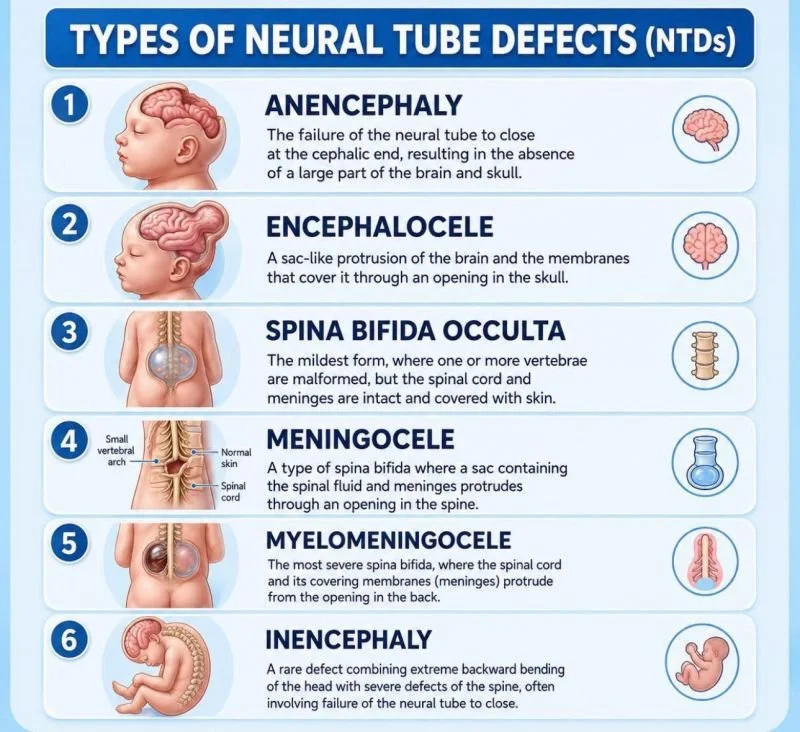
Folate (vitamin B9) is essential during this stage because it supports DNA synthesis and cell division, both of which are particularly important during early pregnancy with the rapid growth of the embryo, so demand is at an all time high.
Put simply, if the mother doesn’t have enough folate, the neural tube can fail to close.
Why folic acid?
Folate is the name for a family of vitamins (vitamin B9) found naturally in foods such as leafy greens, beans, and lentils.
Folic acid is the synthetic form used in supplements and food fortification. It has been proven to survive cooking, last for long periods of time in storage, unlike many natural forms of vitamins. It is well studied that taking folic acid before conception and during early pregnancy has been shown to reduce the risk of neural tube defects by improving a mother’s folate status.
The UK currently recommends that women who are trying to conceive take 400 micrograms (mcg) of folic acid daily, ideally starting three months before conception and continuing through the first 12 weeks of pregnancy. This way, the mother’s folate status is sufficiently high to help the baby’s neural tube fully develop in the first 28 days of pregnancy.
However, there are two important challenges:
Approximately half of UK pregnancies are estimated to be unplanned, meaning many women may not be taking folic acid before conception.
Even among women planning pregnancy, supplementation isn't always started early enough or taken consistently.
Fortifying flour provides a way to increase folic acid intake across the population, without relying entirely on individual awareness or supplement adherence.
What difference is it expected to make?
The policy is expected to reduce the number of affected pregnancies by around 200 cases each year. This is based on modelling and evidence from countries that already fortify flour, rather than a guaranteed exact annual outcome. The UK will monitor the impact following implementation.
When was this announced?
2006: The Scientific Advisory Committee on Nutrition (SACN), the UK's independent nutrition advisory body, first recommended mandatory folic acid fortification.
2017: SACN reviewed the evidence again and reaffirmed its recommendation.
September 2021: The four UK governments announced their intention to introduce mandatory fortification.
November 2024: Legislation was laid in England, with equivalent legislation introduced across the devolved nations.
13 December 2026: The new fortification requirements come into force.
Which flour will be affected?
The legislation applies to non-wholemeal common wheat flour - essentially the refined white and brown wheat flour used in much of the UK's bread and baking.
It does not apply to:
Wholemeal flour
Flour produced by qualifying small mills (less than 500 tonnes annually, subject to the legal production criteria)
Non-wheat flours such as rice, buckwheat, chickpea and maize flour
One important clarification: organic flour is not automatically exempt. Organic white wheat flour will also need to comply with the fortification requirements.
The intention is to make folic acid available through a widely consumed staple food, while retaining alternatives for people who prefer or need to avoid fortified flour.
Did you know white flour is already fortified?
This is perhaps the part that surprises people most. The UK has been adding vitamins and minerals to white flour for decades. Folic acid will be the latest addition to an existing system of mandatory fortification.
Here's what's currently in it:
Calcium carbonate (calcium): introduced in the 1940s. Added partly to compensate for the loss of calcium-rich wheat germ during milling and to improve calcium intake when dairy consumption was more limited.
Thiamin (vitamin B1): introduced during the 1940s and required alongside other nutrients in post-war flour regulations. Thiamin is important for energy metabolism and nervous system function.
Iron: required from the 1950s. Iron is essential for haemoglobin, which transports oxygen around the body, and for normal energy metabolism.
Niacin (vitamin B3): required from the 1950s. Niacin supports energy metabolism and the function of cells throughout the body.
The rationale for adding iron, thiamin and niacin was largely to restore nutrients lost during milling, while calcium was added to improve the nutritional contribution of flour to the diet. The levels of some existing fortificants are also being increased as part of the updated regulations.
So this isn't the first time the nutritional composition of flour has been deliberately changed for public health reasons.
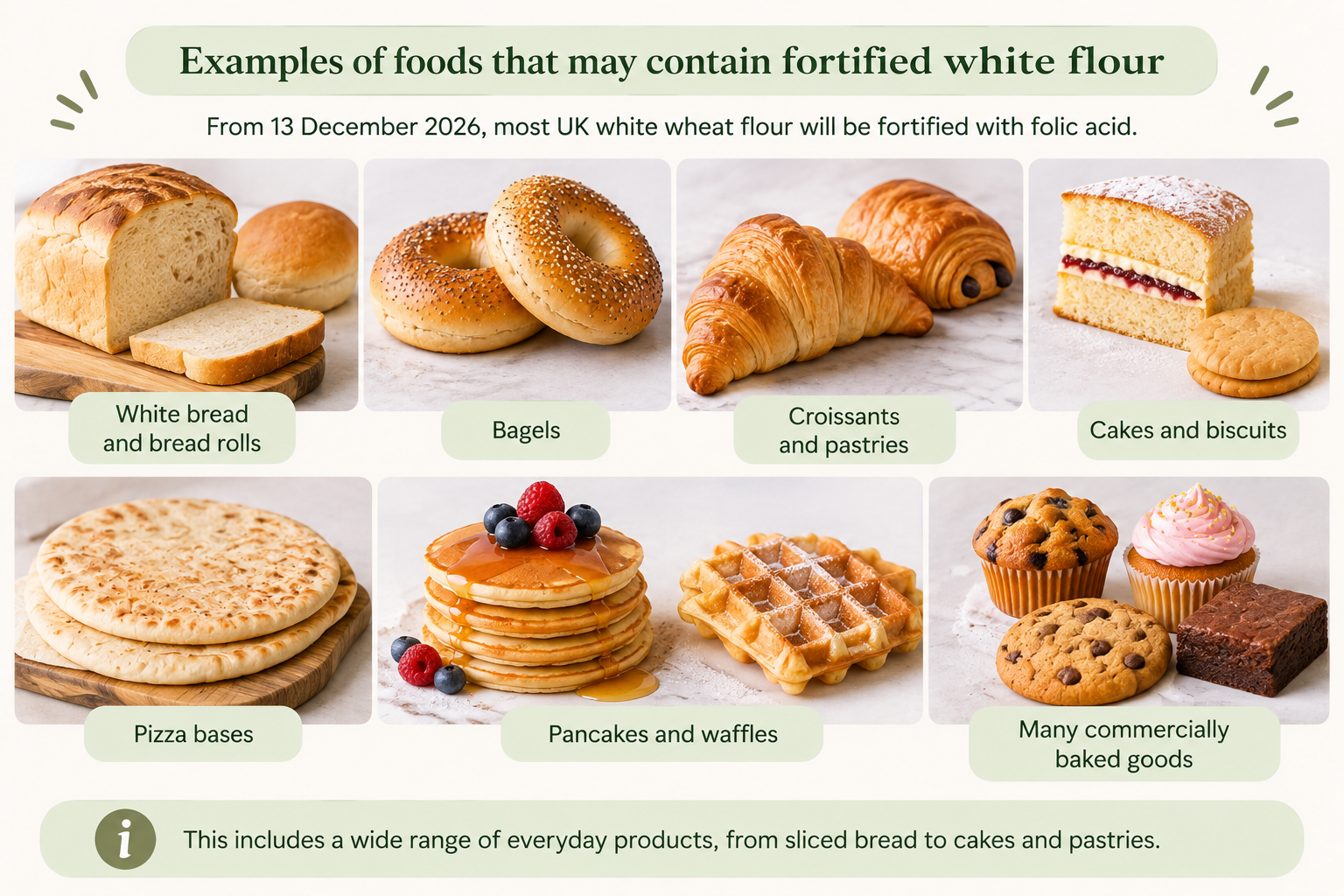
What foods will contain added folic acid?
Think of products made using standard white wheat flour. The actual folic acid content of a finished food will depend on how much flour is used in the recipe.
Folic acid will also appear in the ingredients list, making it easier to identify products made with fortified flour.
Why has there been backlash online?
Most of the concerns I've seen relate to three things:
The difference between folate and folic acid
MTHFR gene variants and methylation
The possibility of folic acid masking vitamin B12 deficiency
Let's unpack these, because the terminology can sound much more alarming than the underlying biology.
1.Folate vs folic acid.
Folate is vitamin B9. Your body uses it in several important processes, including:
Making and repairing DNA
Supporting cell division
Producing red blood cells
Processing certain amino acids
Methylation - a biochemical process involved in regulating gene expression, maintaining DNA and producing certain neurotransmitters.
Folate exists in several forms. Folic acid is the synthetic form used in supplements and food fortification. Our body converts folic acid into forms of folate that can be used in these processes.
2. Where does MTHFR fit in?
One important pathway involving folate is the methylation cycle, which works alongside vitamin B12.
Here's the simplified version:
Folate is converted into different forms within the body.
An enzyme called MTHFR helps convert folate into 5-MTHF (5-methyltetrahydrofolate), the primary active form of folate.
5-MTHF helps convert homocysteine into methionine. Vitamin B12 is essential for this reaction.
Folate is then recycled into a form that can be used again for DNA synthesis.
Some people carry common variants in the MTHFR gene, particularly C677T. These can reduce the activity of the MTHFR enzyme to varying degrees.
But reduced enzyme activity is not the same as an inability to process folic acid.
3. What is the 'folate trap'?
The methyl-folate trap is a genuine biochemical mechanism, but it is primarily associated with vitamin B12 deficiency.
Normally, vitamin B12 helps convert homocysteine to methionine by taking a small group from 5-MTHF. This also allows the active folate (5-MTHF) to be recycled into other forms needed for DNA synthesis.
When B12 is deficient, this reaction slows down.
5-MTHF accumulates because it cannot efficiently donate its methyl group.
Folate becomes less available in other forms needed for DNA synthesis.
This can contribute to impaired DNA synthesis and megaloblastic anaemia.
Importantly, this is not simply what happens when someone consumes folic acid, nor is it an inevitable consequence of having an MTHFR variant.
4. Does having an MTHFR variant mean you can't process folic acid?
This is one of the most widespread claims online.
The evidence does not support the idea that people with common MTHFR variants cannot use folic acid.
According to the CDC:
People with MTHFR variants can process all forms of folate, including folic acid.
One copy of C677T (CT) is generally associated with a modest reduction in enzyme activity.
Two copies (TT) are associated with a greater reduction.
Neither genotype means that folic acid cannot be processed.
Taking 400mcg folic acid daily increases blood folate levels regardless of MTHFR genotype.
The CDC does not recommend testing for common MTHFR variants or changing folic acid intake solely because of these variants.
The key takeaway
MTHFR influences how efficiently one enzyme processes folate. Vitamin B12 is essential for an important step in the methylation cycle and folate recycling. Having an MTHFR variant does not mean you cannot use folic acid, and the folate trap is not evidence that ordinary dietary folic acid will block methylation.
This distinction is particularly important when considering the UK's upcoming flour fortification programme.
Why I think some of the backlash is overhyped
I understand why people are asking questions.
Folic acid is a synthetic nutrient, methylation is an important biological process, and there are legitimate concerns about excessive folic acid intake in certain circumstances.
But I think some of the claims circulating online are disproportionate to the evidence, particularly when it comes to MTHFR.
1. MTHFR variants don't mean folic acid is unusable
As above, even people with the genetic variants can process folic acid.
The NHS continues to recommend 400mcg daily for women trying to conceive, regardless of whether they have a common MTHFR variant.
For women at higher risk of neural tube defects, a GP may recommend a higher 5mg dose.
The reason folic acid is recommended is that it has direct evidence for reducing neural tube defects and improving folate status, regardless of genetic variants.
2. How much folic acid will you actually get from flour?
The UK has chosen a fortification level of: 250mcg folic acid per 100g flour.
This is the amount added to flour, not the amount you'll necessarily consume from a loaf of bread. The amount you consume will depend on how much flour is in your bread, pastries, biscuits and other foods.
The tolerable upper intake level used in UK safety assessments is 1,000mcg (1mg) folic acid daily from relevant sources. This is a safety threshold, not a precise point at which harm suddenly occurs.
To obtain 1mg from flour fortification alone would require 400g of flour in a day, before accounting for other sources. That’s roughly 10-16 slices of bread per day!
That doesn't mean nobody could exceed the threshold - supplements and other fortified foods contribute too - but it gives some perspective on the scale of the fortification dose.
3. What about vitamin B12 deficiency?
This is probably the most legitimate safety concern to discuss.
Historically, high doses of folic acid could improve the anaemia associated with vitamin B12 deficiency without correcting the underlying B12 deficiency.
This matters because vitamin B12 deficiency can cause neurological damage, sometimes irreversible, if left untreated.
The concern is that someone might appear to have improved blood results while their B12 deficiency remains undiagnosed.
However, the distinction is important:
The concern is primarily associated with high folic acid intakes.
The UK has deliberately selected a fortification level intended to minimise the risk of excessive intake.
SACN concluded that folic acid intakes up to 1mg/day were not associated with masking B12-deficiency anaemia.
Countries that have introduced mandatory folic acid fortification have not demonstrated an increase in B12 deficiency prevalence attributable to the policy.
The UK also has established diagnostic pathways for B12 deficiency, including testing B12 status directly rather than relying solely on anaemia.
This doesn't mean the risk is zero, but it does mean that the risk needs to be considered in the context of the actual dose and the evidence.
4. How many people are potentially at risk of B12 deficiency compared with how many pregnancies could benefit?
The NHS estimates vitamin B12 deficiency affects approximately:
1 in 20 people aged 65-74
1 in 10 people aged 75 and over
These are estimates of B12 deficiency, not estimates of people who will experience a ‘folate trap’ or be harmed by fortification.
Only a subset of people with B12 deficiency could potentially be affected by excessive folic acid intake, and the risk depends on dose, duration and whether the deficiency is diagnosed and treated.
Meanwhile, the UK estimates approximately 200 neural tube defect-affected pregnancies could be prevented every year through fortification.
These are not directly comparable populations or outcomes, but they illustrate why public health policy weighs the expected benefits against potential risks rather than assuming that every theoretical risk translates into actual harm.
What should we do?
For most people, I don't think this is something to worry about. But if you'd prefer to avoid added folic acid, there are still options.
1.Choose wholegrain where possible.
Wholemeal flour is exempt from mandatory folic acid fortification. And this is something I'd encourage anyway, for reasons beyond folate. Wholegrain flour retains more of the original grain, including the bran and germ, which means it generally provides:
More dietary fibre
More naturally occurring B vitamins
More minerals
A greater range of plant compounds
Fibre is particularly important for gut health, supporting bowel regularity and providing substrates for beneficial gut bacteria.
Of course, wholegrain isn't automatically better tolerated by everyone, and the overall quality of your diet matters far more than one ingredient.
2. Look for small-scale millers E.g., The Chiltern Flour Co
Qualifying small mills are exempt from mandatory fortification. Some artisan bakeries also use flour from small-scale mills, so if you'd prefer bread made without added folic acid, it's worth asking your local bakery about the flour they use.
Don't assume that artisan, sourdough or organic automatically means unfortified - the source of the flour is what matters.
3. If you're trying to conceive
This is the point I particularly want to emphasise. Please don't stop taking your folic acid supplement because flour is being fortified.
The UK recommendation remains:
400mcg folic acid daily
Ideally starting three months before conception
Continuing through the first 12 weeks of pregnancy
If you have a previous pregnancy affected by a neural tube defect, or certain other risk factors, speak to your GP about whether you need the higher 5mg dose.
Fortification is intended to complement supplementation, not replace it.
About the author
Laura Andreli, Nutritional Therapist
Laura helps clients unlock the powerful connection between the gut and the brain. She specialises in IBS, SIBO, digestive disorders, food sensitivities, and the gut–brain axis - particularly where symptoms such as brain fog, anxiety, low mood, fatigue, and poor concentration may be linked to underlying microbiome imbalance and metabolic stress.
Laura uses evidence-informed nutrition strategies and targeted lifestyle interventions to support digestive function, calm neuroinflammation, and improve energy, mood, and cognitive performance.
Laura’s path into nutritional therapy is personal. While studying at Cambridge, she was diagnosed with Polyendocrine Metabolic Ovarian Syndrome (PMOS; formerly termed PCOS). The experience of receiving a label without clear, actionable guidance shaped her philosophy: translate complex science into practical steps that genuinely help people feel and function better. A former England-level long jumper, she understands first-hand how hormones, metabolism, and nutrition can influence performance, recovery, and cognition.